Odds != Probability
Keith McNulty
(Expert and Author in Applied Mathematics, Data Science, Statistics and Psychometrics. Find me on LinkedIn or Twitter or drkeithmcnulty.com)
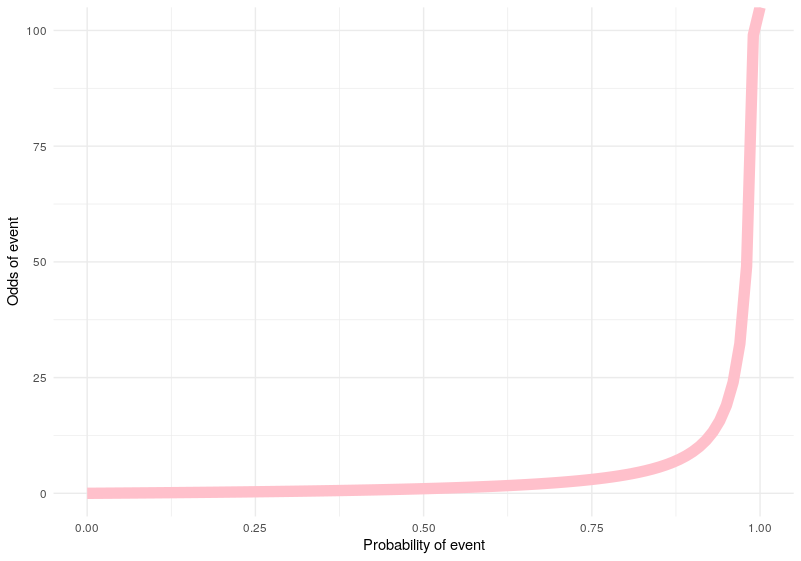
Many people use the words ‘odds’ and ‘probability’ interchangeably. They are both terms that imply an estimate of likelihood or chance. I can understand this for laypeople, but I often see data scientists and statisticians mixing up these concepts also, which is a shame, because mathematically they mean different things.
Although they are both related, odds and probability are very different in scale and meaning. When mixed up in the wrong contexts this can lead to mistaken estimates of chance, which can then lead to erroneous decision making.
In this article, I want to illustrate what those differences are and how, in confusing the two, you can really affect analysis and research.
What is the difference between probability and odds?
Imagine you are putting your hand inside a black bag. Inside that bag are five red balls, three blue balls and two yellow balls.
A probability is defined as the number of occurrences of a certain event expressed as a proportion of all events that could occur. In our black bag there are three blue balls, but there are ten balls in total, so the probability that you pull out a blue ball is three divided by ten which is 30% or 0.3.
Odds is defined as the number of occurrences of a certain event expressed as a proportion of the number of non-occurrences of that event. In our black bag there are three blue balls, but there are seven balls which are not blue, so the odds for drawing a blue ball are 3:7. Odds are often expressed as odds for, which in this case would be three divided by seven, which is about 43% or 0.43, or odds against, which would be seven divided by three, which is 233% or 2.33.
LEGGI TUTTO https://towardsdatascience.com/odds-probability-c9cf80405027