Is Ivermectin For Covid-19 Based On Fraudulent Research? Part 4
The story of ivermectin for Covid-19 continues to get even more worrisome
Gideon M-K; Health Nerd
This is part 4 in what appears to be a deep well of research issues underpinning the entire evidence-base for ivermectin and Covid-19. Part 1 is here. Part 2 is here. Part 3 is here. The study discussed here is also referenced in a BBC investigation.
When I started looking into the evidence-base for ivermectin as a treatment for Covid-19, I saw some bad studies. I expected perhaps one or two to be so terrible that they should never have been published.
I could never have foreseen the multi-part series that this investigation has become. It is not an exaggeration to say that almost all benefits attributed to ivermectin in the treatment of Covid-19 may be based on research that simply never happened at all.
The newest case is of a study that reported vast benefits for the drug, and was eagerly adopted by scientists as evidence that ivermectin could help kill the virus inside people. However, when the author started sending what they said was their data through to independent analysts, the entire study quickly fell apart.
Let’s dig in.
Shonky Science
The study in question was a randomized clinical trial from Lebanon where the authors claimed to have compared ivermectin to a control group receiving normal medical care. The ivermectin group got a single pill of the drug, and over the next three days saw a huge improvement in their viral load, measured by standard PCR tests. The control group were treated with usual drugs and supplements, and saw no such benefit.

Now, these results weren’t just impressive — they were enormous. A common way of comparing the differences you see in clinical trials with each other is using a standardized measurement called Cohen’s d. This number is usually in a range from 0 to 1, with only massive differences reaching a value greater than 1. For example, the difference in average height between adult men and women has a value for Cohen’s d of about 1.4 — this is bigger than almost all differences found in experimental trials.
The Lebanese study claimed to find an effect size of 3.2 in the experimental group. The difference between groups had a Cohen’s d of 2.6. I could not find a single example of real data that actually has an effect size this big anywhere in the literature — all of the examples are of people who made mistakes in their calculations.
So, along with a colleague, I requested data from the authors to check for potential issues in the analysis. This is part of an ongoing investigation into the issues behind ivermectin for Covid-19. What we got back was quite a surprise.
Falling Apart
The first email I received back from the corresponding author on the study asked me to send him $1,500 USD for access to the data. For context, I was not asking for the purposes of doing scientific research, but simply to make sure that the data was on the level. A similar request from my colleague Dr. Sheldrick managed to get the author down to only $1,000. Given that we were doing this work in our spare time, we declined to send through cash, and our emails stopped being answered.

Finally, we were able to get the data through several colleagues who emailed the corresponding authors on our behalf, Dr. Eric Osgood and Dr. Andrew Hill. Their emails were answered quickly, and the data sent through without cost.
Issues of money aside, the dataset that was emailed to several people is quite clearly not data from a real randomized trial. Often, uncovering issues in spreadsheets takes quite a bit of effort, but this dataset is just so obviously problematic that seeing the errors is pretty much immediate when you look at the file.
I’ve uploaded the data that I was sent here, and you can have a look. The basic issue is that the entire dataset is composed of a small number of lines that have simply been copy+pasted a many times. This is most obvious when looking at the height and weight columns, but occurs in almost every numeric column of the data.
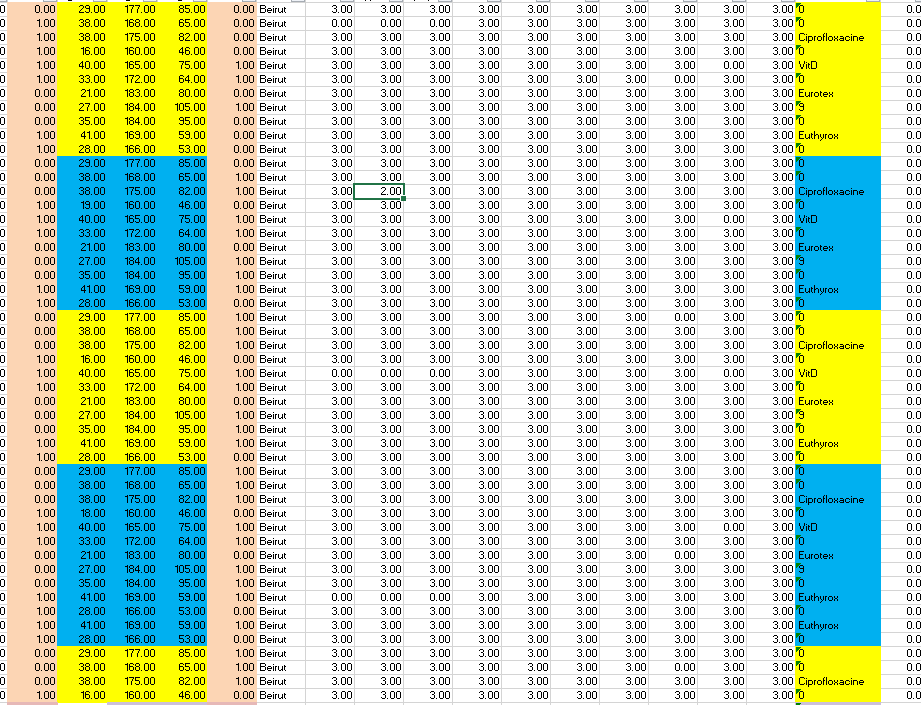
Worse still, the dataset appears to replicate the results in the published study almost exactly. While there are a few minor differences here and there, the fake dataset produces the means and standard deviations from the study to 2 decimal places in almost every case, which means that this was quite likely the data used to generate the results in the study itself.
Dr. Sheldrick and I both confronted the authors of the study on this clear issue. After much back-and-forth, we eventually stopped hearing back from our original sources. Finally, Dr. Eid, a co-author on the research who had not been involved with data collection, agreed that whether or not there was some real data from the research, it was clear that the study itself was based on fake numbers and should be retracted. He has assured both Dr. Sheldrick and I that he has written to the journal to retract the study *.
The Fallout
What does this all mean?
Well, it is yet another blow to the idea that ivermectin is useful for Covid-19. The massive, amazing results seen in this study seem almost certain to have been based on a dataset that was not real. Whether there were actual patients treated or not is in question, and either way the study is being retracted due to the ongoing issues in the dataset used by the research team.
This study did not look at mortality, and so doesn’t change the results for ivermectin and the risk of death that I’ve looked at before, but it nevertheless had a big impact. It has been viewed thousands of times, received 100s of tweets, and was cited academically a dozen times including in three systematic reviews. While this does not necessarily remove the benefit for ivermectin entirely by itself, it is yet another chip in the façade of what increasingly appears to be an overall conclusion on the efficacy of ivermectin that was built largely on fake results.
Ultimately, we may never know exactly what happened here, but we can say it is decidedly not good. With a study already retracted for serious ethical concerns, and two more publicly identified as unlikely to have happened as described, the use of ivermectin as a treatment for Covid-19 is looking less and less reliable as time goes on.
I still genuinely hope that ivermectin works. It would be amazing to have an effective, cheap medication that essentially cured Covid-19 entirely. Unfortunately, the deeper we have looked into the research base, the more pessimistic I’ve become that there is any benefit to be found.
And this is only Part 4. Sign up below for Part 5, and the final conclusion in Part 6.
*It is important to note that we cannot know who among the author team may have been responsible for any issues — it would be incredibly inappropriate to blame an individual for this mess. Moreover, Dr. Eid has been incredibly gracious throughout the process of looking into this data, and I commend him greatly for the difficult decision to retract the paper.